Chinese open-weight AI models are rapidly improving in capability while offering significantly lower operating costs than many proprietary alternatives. But as enterprises evaluate these models, another factor is beginning to shape adoption decisions: geopolitical uncertainty.
The debate is no longer focused solely on model performance or pricing. Instead, businesses are increasingly asking whether the AI model they choose today will still be available through major cloud providers a year from now as U.S. policymakers consider new regulations surrounding Chinese-developed AI technologies.
Performance Isn’t the Only Consideration
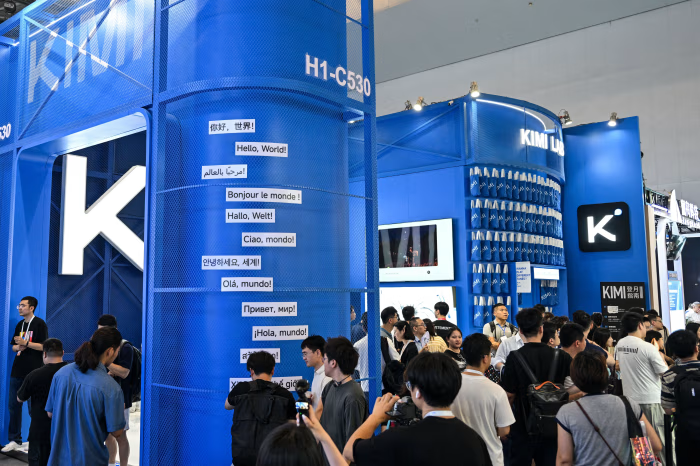
Moonshot AI recently introduced Kimi K3, one of the largest open-weight AI models released to date. Early reactions praised its capabilities, although some observers noted that the model requires substantial token usage, potentially making it more expensive to operate than initial pricing might suggest despite its competitive benchmarks.
This has shifted the conversation away from benchmark scores and toward long-term deployment risks.
For enterprises building products around AI models, regulatory uncertainty can become just as important as technical performance.
Washington’s Policy Debate
Recent discussions among U.S. policymakers have centered on whether Chinese open-weight AI models should face increased regulatory scrutiny.
Rather than pursuing outright bans, proposals reportedly under consideration include stricter federal procurement rules, export restrictions, security advisories, and additional oversight for organizations using Chinese-developed models.
The concern is that introducing enough regulatory uncertainty could discourage adoption within regulated industries, even if no formal prohibition is enacted.
The Economic Impact on AI Competition
The policy discussion also reflects growing competition within the AI industry.
Open-weight models continue to improve while dramatically lowering inference costs, creating pricing pressure for proprietary AI providers that rely on revenue from API usage to justify massive investments in AI infrastructure.
Industry data cited in the report shows open-weight models processing an increasingly large share of production AI workloads while accounting for only a small percentage of overall spending. This demonstrates how enterprises are embracing lower-cost alternatives without necessarily reducing overall AI adoption.
Cloud Providers Could Become the Deciding Factor
One of the biggest implications extends beyond the United States.
Many organizations outside the U.S. access Chinese AI models through cloud platforms such as Microsoft Azure, Amazon Web Services, or Google Cloud rather than hosting the models directly.
If U.S. regulations eventually make hosting Chinese open-weight models more difficult for these providers, businesses across Europe, Asia, and other regions could lose access despite operating outside American jurisdiction. In that scenario, changes to U.S. policy would indirectly influence AI availability worldwide.
Security Concerns Remain
Supporters of increased oversight argue that open-weight models present unique security challenges.
Unlike hosted AI services, downloadable models cannot easily be recalled, patched, or updated once distributed. Organizations running self-hosted versions become responsible for monitoring vulnerabilities, verifying model behavior, and maintaining security over time.
Previous security research has also identified vulnerabilities in some open AI models, while questions surrounding training data provenance and content handling continue to receive attention from regulators and security experts.
The Challenges of Self-Hosting
One potential solution is for organizations to host models themselves rather than relying on cloud providers.
However, that approach is often impractical for today’s largest open-weight models.
According to Moonshot AI, deploying Kimi K3 requires approximately 64 high-performance AI accelerators and model weights totaling roughly 1.4 terabytes. For most enterprises, the hardware investment and operational complexity make self-hosting unrealistic, leaving cloud services as the primary deployment option.
Procurement Decisions Are Becoming More Strategic
For organizations evaluating AI platforms, the question is evolving beyond performance benchmarks or operating costs.
Businesses must now consider long-term platform stability, regulatory exposure, cloud provider support, and migration costs if access to a model changes in the future.
As governments continue shaping AI policy, enterprises adopting open-weight models will likely place greater emphasis on risk management alongside technical capabilities. The future success of these models may depend not only on how well they perform, but also on how reliably organizations can access and deploy them over the coming years.
Source: https://www.artificialintelligence-news.com/news/chinese-open-weight-models-policy-risk/