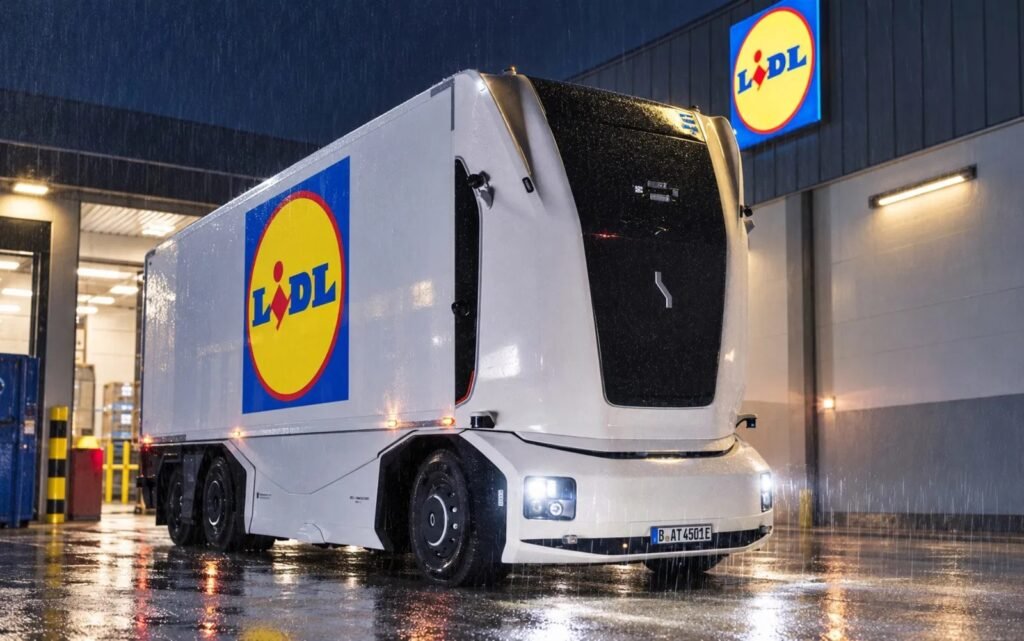
Lidl has begun using a cab-less autonomous electric truck to make regular store deliveries in Germany. The vehicle operates between the retailer’s Edermünde distribution centre and a nearby store, following a designated daily replenishment route.
The truck was supplied by Swedish freight technology company Einride and operates at SAE Level 4 under a permit issued by Germany’s Federal Motor Transport Authority, known as the KBA. Unlike many autonomous vehicle trials, the truck operates without a driver or safety operator inside the vehicle.
Lidl and Einride said the deployment is the first of its kind in Germany involving a cab-less Level 4 truck operating as part of regular daily logistics.
Built For Daily Operations
The autonomous truck can carry up to 15 Euro pallets and complete as many as three trips per day. During the four-month project, Lidl plans to use the vehicle for dry-goods deliveries along the designated route.
The truck is expected to move more than 3,000 pallets during the project. Lidl is using the deployment to evaluate how autonomous transportation can be integrated into its existing logistics operations.
The company has not yet released figures on potential cost savings, delivery times, vehicle utilisation, or productivity improvements. It also has not announced a broader rollout across its network.
Addressing Driver Shortages
Lidl and Einride have connected the project to the ongoing shortage of truck drivers across Europe. The International Road Transport Union estimated that roughly 502,000 truck-driver positions were unfilled across Europe in 2025.
The organisation also expects approximately 20% of Europe’s current truck-driver workforce to retire within five years. Around two-thirds of European operators surveyed said they had rejected new contracts because they could not find enough drivers.
Autonomous transportation could therefore provide another option for maintaining goods movement as logistics companies deal with staffing shortages.
How Level 4 Works
SAE Level 4 is classified as high driving automation. At this level, an automated driving system can perform the driving task without requiring a person to take control, but only within the specific conditions for which the system was designed.
This differs from Level 5 automation, which is intended to operate across all driving conditions.
Germany allows Level 4 vehicles to operate without a driver on public roads within approved operating areas. Its Autonomous Driving Act established the legal framework for these operations, with vehicles required to remain within geographically defined areas.
The KBA is responsible for approving vehicles equipped with autonomous driving functions, while the relevant state authority or Autobahn GmbH approves the operating area.
Human Oversight Remains
Although no driver is physically inside Lidl’s truck, Germany’s framework still requires human technical supervision.
A technical supervisor can deactivate the vehicle or approve certain manoeuvres when intervention is required. However, the law does not require the supervisor to continuously monitor the vehicle while it is operating autonomously.
The vehicle must also be capable of entering a minimal-risk state if it reaches its operating limits or can no longer continue as intended. This involves stopping at the safest available location and activating its hazard warning lights.
Multiple Safety Systems
Einride said its autonomous driving system combines machine-learning-based navigation with an independent deterministic safety checker.
The truck uses multiple sensors, including lidar, radar, and cameras. Einride said the technology has been tested through simulation, hardware- and vehicle-in-the-loop testing, proving grounds, and site validation before deployment.
Parts of the company’s autonomous technology have also undergone external review. Swedish research institute RISE reviewed aspects of Einride’s control system, including obstacle detection and cybersecurity, as part of an application involving autonomous vehicle trials in Sweden.
A separate assessment by TÜV SÜD was also initiated to examine the governance processes behind Einride’s autonomous Safety Management System.
Moving Toward Multi-Stop Routes
The current Lidl deployment connects one distribution centre with a single nearby store. Following validation of the route, Lidl plans to expand the concept through a multi-stop “milkrun” model at another location.
A milkrun combines multiple collection or delivery points into one scheduled route. For Lidl, this would expand the autonomous operation beyond the current single distribution-centre-to-store connection.
Lidl operates more than 3,250 stores and 39 administrative and distribution centres in Germany. However, the company has not announced plans to deploy autonomous vehicles throughout its wider network.
Previous Autonomous Deployments
Einride has already moved autonomous trucking beyond public-road testing into recurring logistics operations with GE Appliances in Tennessee.
That project began with a two-week public-road pilot before an autonomous vehicle entered full-time daily operations. The vehicle was scheduled to make up to seven trips per day between a factory and warehouse.
The GE Appliances operation also incorporated other automated systems. AI-enabled cameras were used to operate dock equipment, while an autonomous mobile robot loaded and unloaded the truck. GE Appliances reported that the system reduced loading times by 80%.
Unlike Lidl’s German deployment, the GE Appliances operation retained a remote Einride operator to monitor the vehicle.
Expanding Autonomous Logistics
Lidl and Einride are using the current project to determine how driverless transportation can function as part of everyday logistics rather than as a limited technology demonstration.
The companies have also indicated that additional autonomous deployments involving other Schwarz Group companies are being discussed. No timetable or vehicle count has been announced for those potential projects.
The Lidl deployment demonstrates how autonomous trucking is moving into defined real-world delivery routes while operating within regulatory frameworks that still maintain human oversight and safety requirements.
Source: https://www.artificialintelligence-news.com/news/lidl-autonomous-truck-germany/