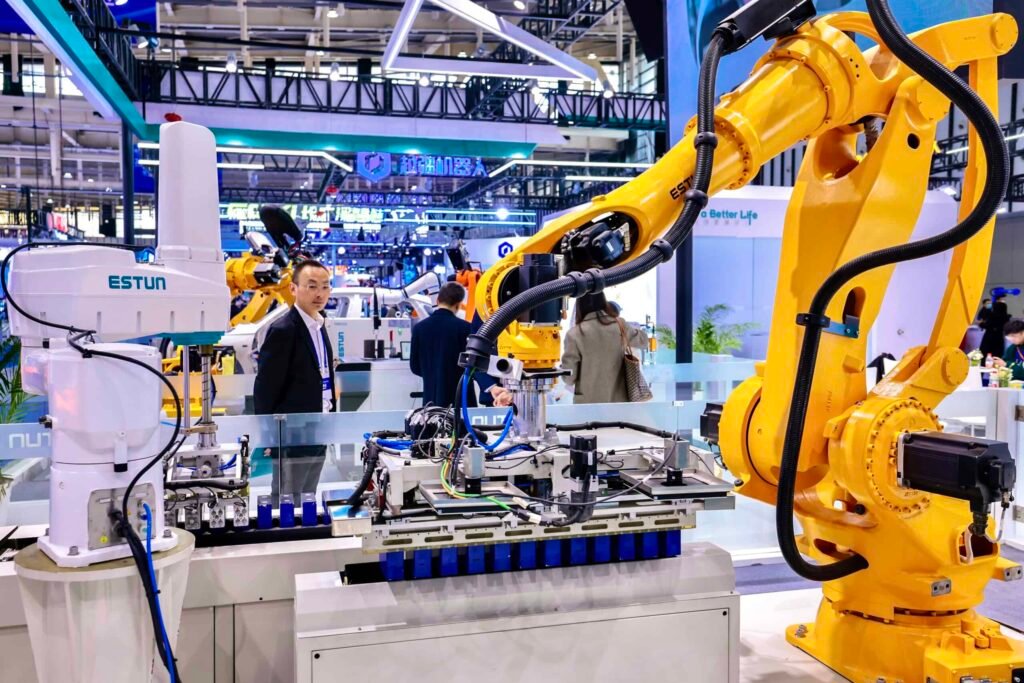
The next phase of artificial intelligence is moving beyond software and into the physical world. Companies are increasingly combining AI with physics-based simulation to design, test, and deploy real-world systems more efficiently.
This shift is especially visible in engineering-heavy industries, where accuracy, safety, and performance depend on understanding how systems behave under real conditions before they are ever built.
Simulation becomes the foundation
A major development in this space is the integration of AI with advanced simulation environments. By combining accelerated computing with physics-based models, engineers can simulate everything from semiconductor behavior to large-scale infrastructure systems.
These simulations account for thermal, mechanical, and electrical interactions, allowing teams to evaluate how complex systems will perform in real-world environments. Instead of relying on costly trial and error, organizations can validate designs virtually before deployment.
Training robots without the real world
One of the most impactful applications is in robotics. AI models used to train robots are increasingly being developed in simulated environments rather than through physical data collection.
This approach significantly reduces costs and speeds up development. However, the effectiveness of these models depends heavily on the accuracy of the simulation itself. High-quality, physics-based data ensures that robots trained virtually can perform reliably in real-world scenarios.
As a result, simulation is no longer just a testing tool—it is becoming a core component of the training process.
Digital twins reshape industrial workflows
Digital twin technology is playing a central role in this transformation. By creating physically accurate virtual replicas of machines, production lines, and entire systems, engineers can test different configurations and optimize performance before implementation.
This is particularly valuable in industrial environments, where even small inefficiencies can lead to significant costs. Virtual testing enables faster iteration and better decision-making without disrupting real operations.
Cloud-powered chip design automation
At the same time, AI is reshaping semiconductor design. New AI-driven systems are automating complex stages of chip development, particularly the transition from conceptual design to physical layout.
These systems can interpret design requirements and execute tasks across multiple stages of the development process. By leveraging cloud infrastructure, teams can run these workloads at scale without relying on local hardware.
This not only accelerates development timelines but also makes advanced design tools more accessible.
From assistance to autonomy in engineering
AI in engineering is evolving from a supportive tool into a more autonomous system. Instead of simply assisting with tasks, modern AI platforms can coordinate workflows, make decisions, and execute processes across different stages of development.
Early results suggest significant productivity improvements, with some workflows seeing substantial efficiency gains. While still developing, this trend points toward a future where AI plays a central role in managing complex engineering systems.
The role of AI in quantum computing
Beyond robotics and chip design, AI is also beginning to influence quantum computing. New AI models are being developed to improve quantum system performance, particularly in areas like error correction and system calibration.
Quantum systems are inherently fragile, and maintaining stability is one of the biggest challenges in making them practical. AI-driven approaches aim to address this by acting as a control layer that improves reliability and scalability.
A broader shift in how systems are built
What ties all of these developments together is a fundamental shift in how complex systems are designed and deployed. Simulation, AI, and cloud computing are converging to create a more efficient and predictable development process.
Instead of building first and testing later, organizations can now simulate, optimize, and validate systems before they ever exist physically. This reduces risk, lowers costs, and accelerates innovation.
The future of AI-driven engineering
As these technologies continue to evolve, the line between digital and physical systems will continue to blur. AI will not just power software—it will shape how machines are built, how infrastructure is designed, and how entire industries operate.
The result is a new era of engineering where intelligence is embedded not just in code, but in the physical world itself.