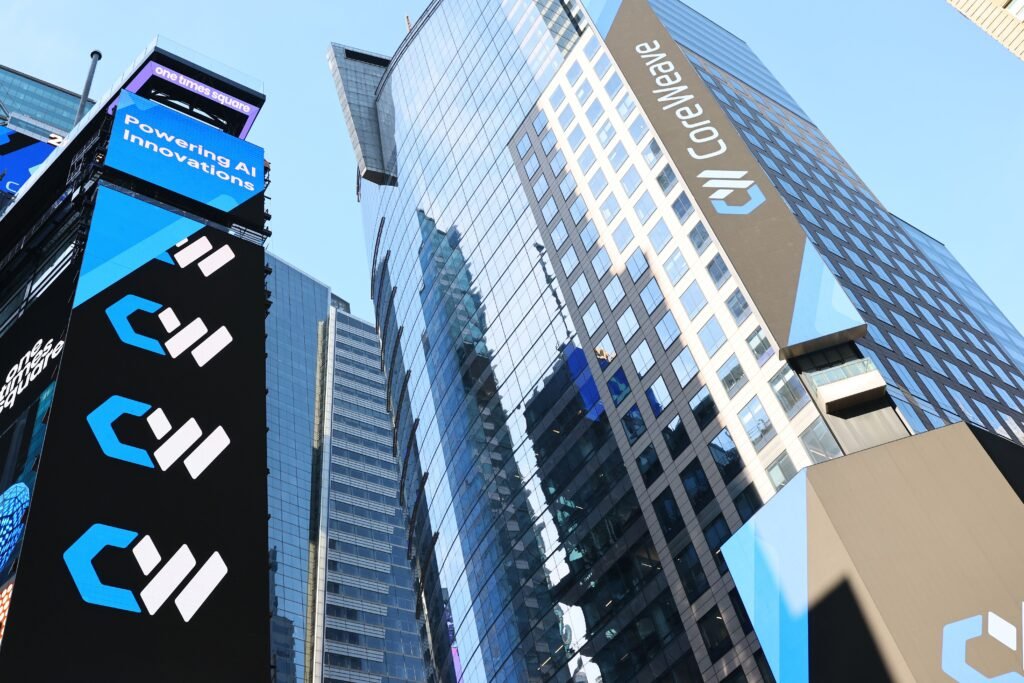
A sharp decline in CoreWeave’s corporate bonds is raising concerns about the financial risks associated with the rapid expansion of artificial intelligence infrastructure. As data centre operators commit billions of dollars to computing capacity, investors are becoming more cautious about debt-funded projects that may take years to generate sufficient revenue.
The selloff highlights growing scrutiny of borrowing costs, leverage, and the long-term economics of AI infrastructure. Market participants are increasingly questioning whether expected demand for AI computing will justify the scale of investment currently underway.
CoreWeave Debt Signals Growing Investor Caution
CoreWeave’s bonds, issued in June with a yield of 9.675%, saw their yields rise to approximately 15% during the selloff. The move indicates that investors are demanding substantially higher returns to hold the company’s debt as concerns about AI infrastructure financing intensify.
Max Frumes, global head of distressed and leveraged finance at credit data company 9fin, described CoreWeave as an early warning sign for a market segment facing mounting pressure. He expects financing for AI-related projects to become more expensive, with lenders applying greater scrutiny to borrowers’ financial structures and ability to repay debt.
The pressure has also affected CoreWeave’s shares, which fell 15.1% from Monday’s opening through Thursday’s close. A 6% gain on Thursday followed a show of confidence from Nvidia, one of the company’s key partners. Other AI infrastructure providers, including Nebius and Iren, experienced similar share-price weakness.
For credit investors, however, the bond market’s reaction may be particularly significant because it reflects concerns about the underlying financial commitments required to build and operate large-scale AI infrastructure.
AI Infrastructure Spending Faces a Financing Test
Building AI data centres requires substantial upfront investment in facilities, power infrastructure, and graphics processing units (GPUs). These expenses can accumulate well before a project generates enough revenue to cover its costs.
Investors are increasingly concerned about the timing mismatch between capital spending and returns. Projects may require years to reach full operational capacity, leaving companies dependent on external financing while they build out their infrastructure.
The risks include high leverage, continued reliance on borrowing, and the possibility that computing hardware could become obsolete before newly constructed facilities begin operating at scale.
These concerns were less prominent during the earlier stages of the AI investment boom, when expectations for future demand encouraged investors to finance aggressive expansion plans.
The market’s changing attitude suggests that investors are beginning to place greater emphasis on financial resilience and the ability of AI infrastructure providers to generate sustainable cash flows.
Deutsche Bank’s global head of macro and thematic research, Jim Reid, has highlighted the growing importance of credit markets as AI capital expenditure increasingly relies on debt rather than companies’ internally generated cash.
As borrowing becomes a more important source of funding, movements in credit markets may offer an increasingly useful indication of investor confidence in the sustainability of AI investment.
Credit Investors Become More Selective
The CoreWeave selloff is prompting investors to reassess their exposure to AI infrastructure debt.
John Han, a portfolio manager at fixed-income investment firm F/m Investments, said the firm is reviewing risks across the sector, particularly where leverage is concentrated and investors may not be receiving sufficient compensation for the risks involved.
One of the firm’s exchange-traded funds holds unsecured CoreWeave bonds because they form part of its tracked index. Han indicated that the securities warrant another look at their current yields.
He generally prefers high-yield investments structured through special purpose vehicles, which may offer additional collateral and lower risk in exchange for lower returns.
Larry Holzenthaler, a senior portfolio manager at Catalyst Funds, also described a market increasingly focused on companies with elevated leverage and challenging operating conditions.
However, some investors believe the shift in sentiment may have become excessive. After a period of strong optimism about AI, markets could now be overcorrecting by treating a broader range of infrastructure investments with greater pessimism.
Even so, the selloff demonstrates that enthusiasm for AI does not automatically translate into confidence in every financing structure supporting its expansion.
Inflation and Data Centre Permitting Add Pressure
Higher borrowing costs are not the only challenge facing AI infrastructure developers. Rising inflation is increasing financing expenses, while political debate surrounding data centre construction is creating additional uncertainty.
Data centres require substantial amounts of electricity, making power availability and energy prices important factors in project economics. Permitting processes can also delay construction, potentially extending the period before an investment begins generating revenue.
Technology analyst Dan Ives of Yorkville Ives estimates that between 5% and 10% of planned AI projects may ultimately never be built.
Concerns surrounding data centre permitting and political discussions about electricity prices are giving investors additional reasons to reassess their exposure to the sector.
Delays or cancellations could leave developers with significant sunk costs, particularly if they have already borrowed heavily or committed to purchasing expensive computing equipment.
These risks reinforce the importance of evaluating individual projects based on their financing arrangements, construction timelines, infrastructure requirements, and expected revenue rather than relying solely on broad expectations for AI demand.
AI Infrastructure Enters a More Disciplined Phase
The pressure on CoreWeave’s bonds suggests that the financing environment for AI infrastructure may be entering a more demanding phase.
Investors are no longer evaluating the sector exclusively through the lens of projected AI growth. They are also examining how companies fund their expansion, how quickly their investments can generate returns, and whether their debt obligations remain manageable under less favourable conditions.
For data centre operators, this could mean higher borrowing costs, stricter financing terms, and greater pressure to demonstrate clear paths to profitability. Projects with high leverage, uncertain demand, or significant construction risks may face particular difficulties securing funding.
The broader AI investment cycle is unlikely to be determined by a single company’s bond performance. However, CoreWeave’s selloff illustrates how credit markets can expose financial vulnerabilities that may be less visible when attention is focused on rising AI demand and expanding computing capacity.
As infrastructure spending continues, the availability and cost of financing could become just as important as technological progress in determining which AI projects move forward and which are ultimately abandoned.