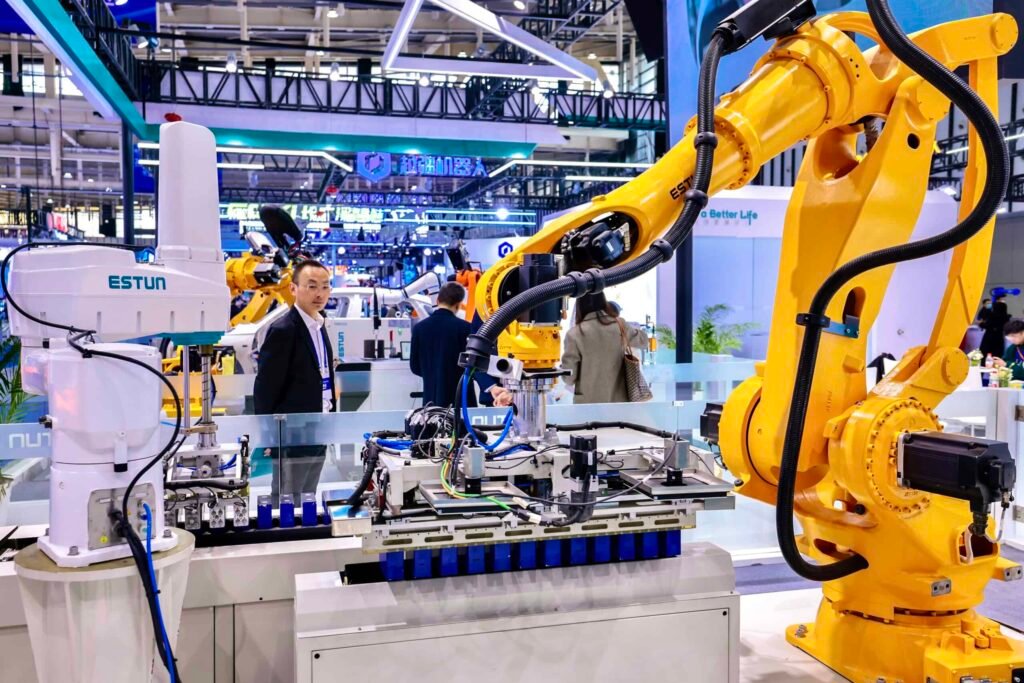
Japan has officially launched one of the world’s most ambitious artificial intelligence and robotics initiatives, announcing plans to deploy 10 million AI-powered robots across 18 industries by 2040. Backed by government funding of up to one trillion yen (approximately US$6.1 billion) over five years, the initiative is designed to help address the country’s growing labor shortage while positioning Japan as a global leader in physical AI.
Rather than serving as a long-term vision, the strategy has already entered its implementation phase with government-backed research and development now underway.
Building a national AI robotics platform
Japan’s Ministry of Economy, Trade and Industry (METI) and the New Energy and Industrial Technology Development Organization (NEDO) have formally commissioned technology company Noetra and the National Institute of Advanced Industrial Science and Technology (AIST) to develop a next-generation physical AI foundation model.
The project will run from fiscal 2026 through 2030 and focuses on creating a multimodal AI system capable of understanding language, images, video, and sensor data simultaneously. Unlike traditional industrial robots that rely on fixed programming, the new AI models are intended to help robots interpret real-world environments and make intelligent decisions in dynamic situations.
An initial version of the model is expected during the first year of development, with annual improvements planned throughout the project.
Funding tied to performance
Although the initiative carries a headline value of up to one trillion yen, the government has structured funding around performance milestones rather than guaranteeing the full investment.
The current fiscal year’s commission is valued at approximately US$2.3 billion, funded through Japan’s GX Economy Transition Bonds. However, only the first two years of funding have been fully approved.
Future investments will depend on annual reviews through a stage-gate evaluation process, allowing the government to adjust or reduce funding if development targets are not achieved.
A consortium of Japanese technology leaders
The project is being developed by Noetra, a consortium backed primarily by several of Japan’s largest technology and manufacturing companies.
Current major stakeholders include SoftBank, NEC, Sony Group, and Honda, while reports indicate Fujitsu and Rakuten are also considering participation.
Researchers from Preferred Networks, SoftBank, and AIST are working together to develop the AI foundation model, combining expertise in robotics, imaging technology, artificial intelligence, and industrial automation.
The collaborative approach reflects Japan’s strategy of leveraging existing strengths across multiple industries rather than relying on a single company to lead development.
Solving Japan’s labor shortage
The primary motivation behind the initiative is Japan’s increasingly severe workforce shortage.
An aging population and declining birth rate have created labor gaps across industries including healthcare, food manufacturing, hospitality, logistics, and elder care. Government officials believe AI-powered robots can help offset these shortages by performing tasks that are becoming increasingly difficult to staff.
Industry Minister Ryosei Akazawa said the initiative is intended to accelerate the practical deployment of AI-powered robotics throughout the economy, particularly in sectors facing the greatest workforce challenges.
Japan already has decades of experience developing robotics for manufacturing, disaster response, healthcare, and hazardous environments such as the Fukushima Daiichi nuclear cleanup. The new strategy seeks to build upon that expertise while creating technologies that can also be exported internationally.
Competing in the era of physical AI
The announcement comes as countries around the world increase investment in AI-driven robotics.
Unlike recent competition centered on large language models and cloud AI services, governments are now shifting attention toward physical AI—systems capable of interacting directly with the physical world through robots and autonomous machines.
Japan’s announcement was quickly followed by South Korea unveiling its own robotics initiative, highlighting a growing international race to develop intelligent robotic platforms for commercial and industrial use.
Looking ahead
While the long-term goal of deploying 10 million AI-powered robots by 2040 has attracted global attention, the project’s immediate success will depend on its early development milestones.
The first major benchmark will be the release of Noetra’s initial AI foundation model and its subsequent government performance review. If development progresses as planned, additional industry partners and investment are likely to follow.
With strong backing from both government and major technology companies, Japan is positioning itself to become a leader in the emerging field of physical AI, where intelligent robots may play an increasingly important role in addressing labor shortages and reshaping industries worldwide.
Soure: https://www.artificialintelligence-news.com/news/japan-ai-robots-2040-national-ai-model/