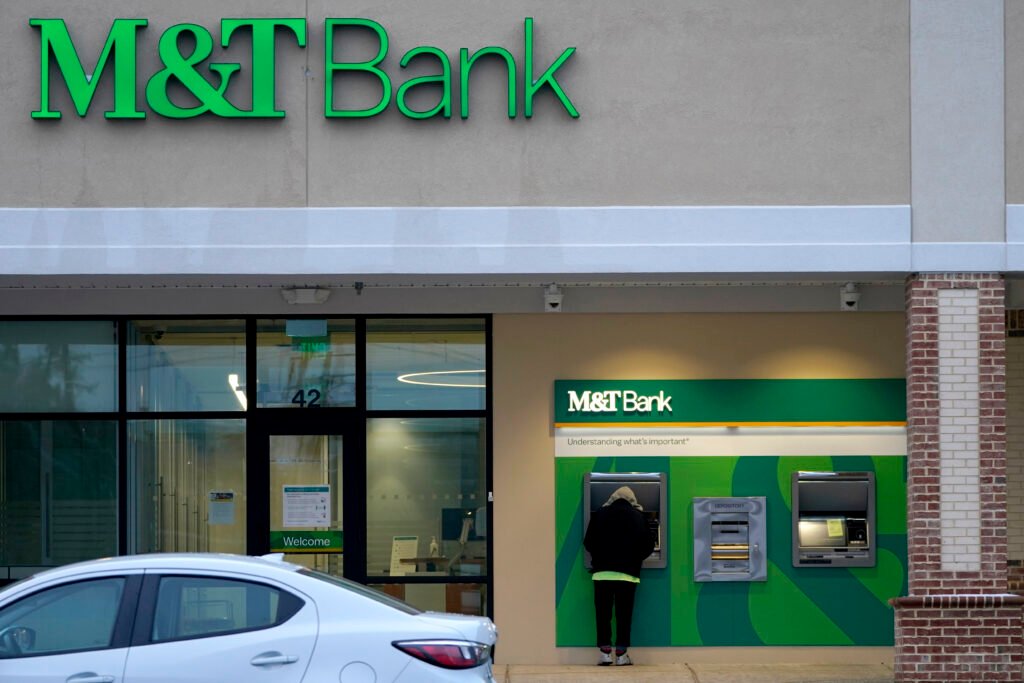
M&T Bank is expanding its use of artificial intelligence across the organisation, with AI copilots now being used by more than 15,000 employees. The regional bank is applying the technology to internal operations, customer service, software development and risk management as part of a broader technology transformation.
From experimentation to everyday use
M&T’s AI strategy goes beyond giving employees access to a general-purpose chatbot. The bank is incorporating AI into existing workflows while also developing systems built around its own data and processes.
Employees are using AI to analyse call-centre conversations, draft reports, generate code, identify customer needs and flag potential portfolio risks. The bank is also exploring agentic AI for areas such as cybersecurity and fraud detection.
The expansion followed an initial period in which M&T restricted access to public large language models. The concern was that employees could accidentally enter sensitive company information into public-facing AI services.
The bank subsequently evaluated enterprise AI providers and selected Microsoft Copilot. An initial pilot involving approximately 800 employees eventually expanded across the organisation.
AI is already saving employee time
One of M&T’s early use cases demonstrates how relatively simple AI applications can produce measurable productivity gains.
The bank uses generative AI to summarise call-centre conversations, saving approximately six minutes per call. Software developers also use GitLab tools to assist with code generation, although employees remain responsible for reviewing AI-generated work.
The bank has since moved into more sophisticated applications, including identifying customer needs and flagging risks within investment portfolios.
Building the foundation for AI
M&T’s expansion of AI has been supported by a much larger technology overhaul that began several years earlier.
The bank has increased the proportion of its technology workforce that is employed internally, replacing dozens of older platforms and expanding its technology organisation to approximately 2,000 technologists working across more than 300 agile teams. It has also hired more than 1,000 technology specialists as part of the programme.
The investment has coincided with significant improvements in the bank’s technology infrastructure. M&T says technology outages have fallen by more than 80%, while the number of system upgrades completed each year has increased by 300%. Technology spending exceeded $1.2 billion, nearly three times its level several years earlier.
Data governance is critical
M&T has also invested heavily in understanding and governing its data.
The bank developed a data-lineage programme that tracks where information originates, how it is used and how it moves between systems. The initiative was not created specifically because of generative AI, but it has become an important capability as the bank deploys AI across its operations.
M&T has established a Data Academy focused on data governance and skills, with around 2,000 employees participating. It has also created an internal repository called Edison that contains authoritative information and bank policies.
The bank uses data-lineage technology from Solidatus and Monte Carlo to track information across databases, applications and business-intelligence systems. This gives M&T greater visibility into the source, meaning, quality and governance of its data.
That foundation also supports M&T’s use of retrieval-augmented generation with internal, governed data.
Three approaches to enterprise AI
M&T’s technology leadership has outlined three primary approaches to generative AI.
The first is general employee use, allowing workers to use AI tools for everyday tasks. The second involves AI capabilities embedded within existing applications, allowing employees to access AI without necessarily adopting an entirely new platform. The third is proprietary AI systems built around M&T’s own data, workflows and business processes.
This approach is particularly relevant for a bank because M&T operates more than 1,800 applications, many of which are supplied by third-party vendors. Rather than rebuilding every system, the bank can identify useful AI capabilities already incorporated into those applications while developing custom systems where its own data and processes provide an advantage.
AI across the banking industry
M&T is not alone in expanding AI throughout its workforce.
JPMorganChase has deployed its internal LLM Suite to hundreds of thousands of employees, while its Corporate and Investment Bank has seen significant adoption of the platform. The bank has also reported extensive use of AI coding assistants among its engineers and has applied AI to transaction screening.
Bank of America is similarly using generative AI through EricaAssist, which supports more than 18,000 customer service employees. The system can summarise why a customer is calling, retrieve relevant information and recommend possible next steps while leaving the employee responsible for the interaction.
Human oversight remains essential
For financial institutions, deploying AI is not simply a question of increasing productivity. Banks must also protect confidential information and maintain accountability for decisions and communications.
M&T’s Code of Business Conduct and Ethics requires employees to use approved AI tools and prohibits confidential, proprietary, customer, employee or regulated information from being entered into unapproved systems. Employees also remain responsible for the accuracy and appropriateness of work produced with AI assistance.
This approach highlights a broader trend in enterprise AI: the technology is increasingly being integrated into everyday work, but human employees remain accountable for the final output.
The next phase of enterprise AI
M&T’s experience illustrates how enterprise AI adoption depends on more than simply purchasing access to an AI model.
The bank’s expansion has been accompanied by years of investment in technology infrastructure, data governance, internal talent and application modernization. That foundation gives the organisation the ability to deploy AI while maintaining greater control over sensitive financial information.
As AI moves from experimentation into core banking workflows, the most significant advantage may come not from having access to the newest model, but from having the infrastructure and governed data needed to use AI effectively across an entire organisation.
Source: https://www.artificialintelligence-news.com/news/mt-bank-enterprise-ai-15000-employees/