The race to bring humanoid robots into real-world industrial environments is accelerating as manufacturers and AI startups move beyond demonstrations and begin testing physical AI systems inside active workplaces.
One of the clearest signs of that shift comes from British robotics company Humanoid, which plans to deploy humanoid robots across factories operated by German industrial supplier Schaeffler. The agreement reportedly covers between 1,000 and 2,000 robots that could eventually be deployed across Schaeffler’s global manufacturing operations over the next several years.
The first installations are expected to begin at facilities in Germany, where the robots will initially handle material movement and box transportation inside existing production environments.
Manufacturing Becomes the First Major Testing Ground
Factories are emerging as one of the earliest large-scale use cases for physical AI systems. Unlike consumer robotics, industrial environments offer structured workflows, predictable layouts, and repetitive physical tasks that make them ideal for early deployment.
Humanoid’s systems are expected to assist with warehouse and production-line operations, particularly tasks involving repetitive movement of goods and materials. The company is also helping integrate the robots into Schaeffler’s existing manufacturing infrastructure rather than creating entirely separate workflows.
The partnership extends beyond software and robotics deployment. Schaeffler will reportedly become a preferred supplier for Humanoid’s actuator systems, which are critical components responsible for robotic movement and control.
The agreement highlights how robotics companies are increasingly building long-term supply chain partnerships as they prepare for scaled production.
Physical AI Is Expanding Beyond Factories
The push toward humanoid robotics is not limited to manufacturing plants. Across Asia, companies are beginning to collect massive amounts of human movement data to train robots for physical workplace tasks.
South Korean AI startup RLWRLD has been gathering worker motion data from hotels, warehouses, logistics operations, and retail environments. Employees are recorded performing detailed physical tasks such as folding napkins, organizing displays, preparing tableware, and moving inventory.
Using cameras, motion sensors, VR systems, and tracking gloves, the company converts human movements into machine-readable training data that can later be used to train robotic systems.
The focus is not simply teaching robots how to move from point A to point B. Engineers are attempting to replicate the fine motor skills and dexterity required for complex physical work, including grip strength, object handling, and coordinated motion.
That challenge remains one of the biggest barriers preventing humanoid robots from operating effectively in dynamic human environments.
Teaching Robots Human Dexterity
Much of the current development effort in physical AI revolves around helping robots manipulate objects with greater precision.
RLWRLD engineers reportedly capture details such as joint angles, movement timing, and the amount of force workers apply during different tasks. That information is then used to train robotic systems capable of repeating those motions autonomously or semi-autonomously.
Some demonstrations already show robots completing relatively sophisticated actions. In testing environments, humanoid systems have been shown organizing minibar items, packing boxes, and placing products onto conveyor belts.
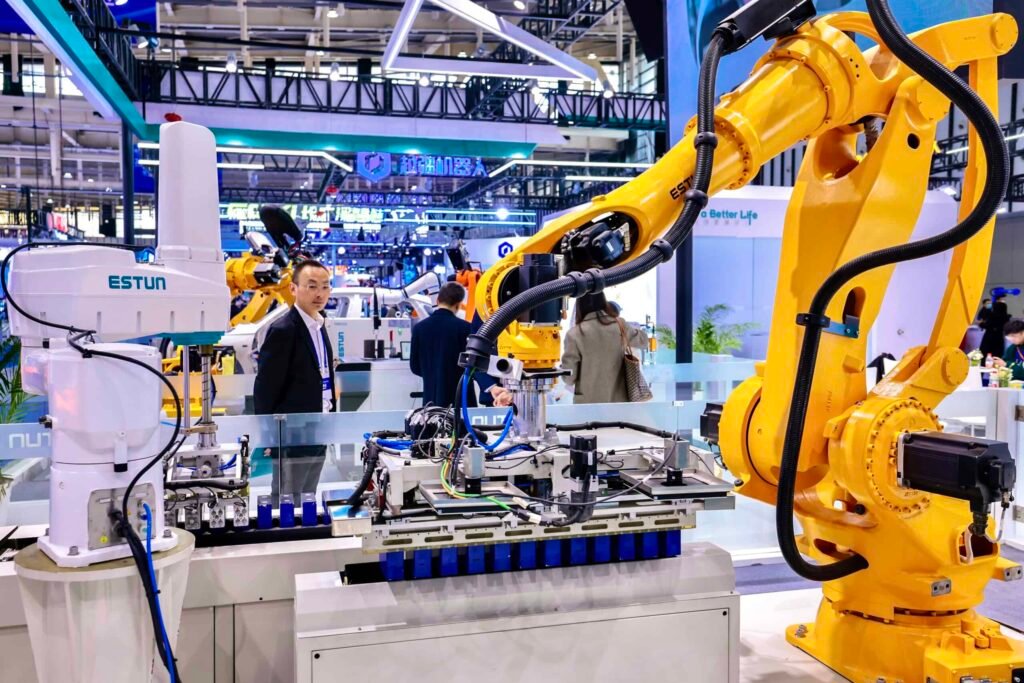
While these demonstrations still occur in controlled settings, they represent a major step beyond traditional industrial robotics, which typically perform highly repetitive motions inside fixed cages or production cells.
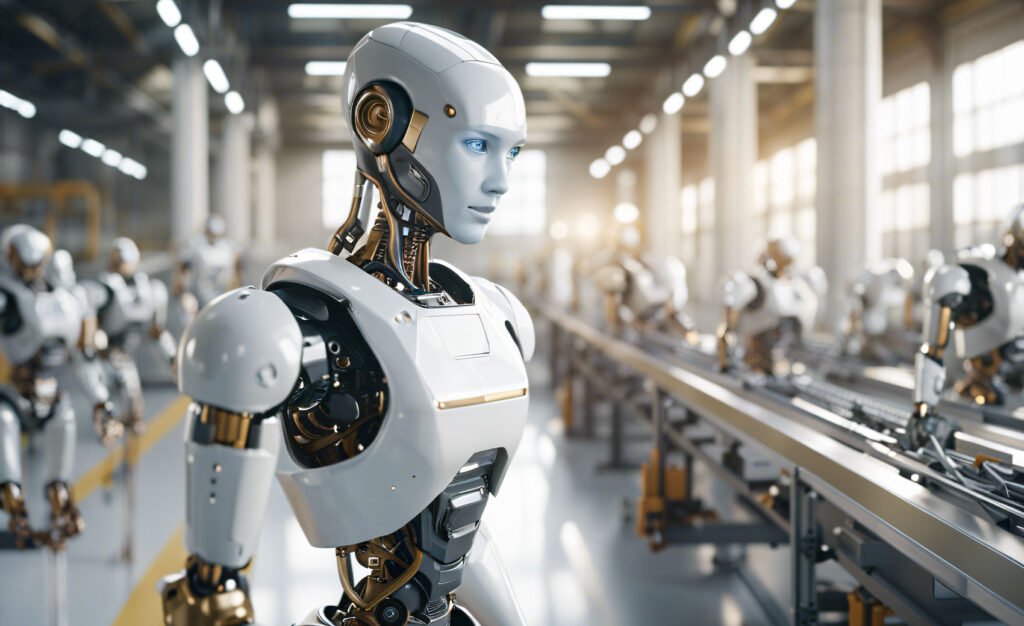
Humanoid robots, by contrast, are being designed to operate in spaces originally built for people.
Major Corporations Are Preparing for AI-Driven Factories
Large manufacturers are increasingly signaling that humanoid robotics will play a role in future industrial operations.
Hyundai Motor has discussed deploying humanoid robots developed by Boston Dynamics inside global manufacturing facilities later this decade. Samsung Electronics has also outlined plans to transform its production sites into AI-driven factories that combine automation systems, robotics, and autonomous workflows.
Many companies view labor shortages, rising operational costs, and aging populations as major drivers behind these investments.
Physical AI systems could eventually help companies maintain production capacity in industries struggling to hire enough workers for physically demanding or repetitive jobs.
Labour Concerns Continue to Grow
As companies push toward automation, labor organizations are raising concerns about the long-term impact on employment and workforce development.
Worker groups in South Korea have warned that large-scale robot deployment could reduce opportunities for skilled labor and weaken training pipelines for future workers. Critics also question how employee motion data is being collected and used to train commercial AI systems.
Businesses experimenting with humanoids argue that the technology will initially support workers rather than fully replace them. Many of today’s robots still operate far slower than humans when performing detailed physical tasks.
For example, hotel operators testing cleaning robots say current humanoid systems would take several hours to clean a guest room that human workers can finish in under an hour.
Still, companies believe the technology will improve rapidly over the next few years.
Some hospitality operators already expect robots to handle portions of back-of-house operations later this decade, particularly repetitive preparation and logistics tasks that involve limited customer interaction.
The Bigger Shift Toward Physical AI
The recent surge in robotics investment reflects a broader industry transition from digital AI systems toward physical AI — artificial intelligence that can interact directly with the real world.
Generative AI transformed how machines process language and information. Physical AI aims to extend that intelligence into movement, manipulation, and autonomous decision-making inside real environments.
The challenge is significantly harder because robots must interpret constantly changing physical conditions while safely interacting with people, objects, and machinery.
Even so, the pace of development is accelerating quickly. What was once confined to research labs and promotional demos is now beginning to enter factories, warehouses, hotels, and retail operations around the world.
Source: https://www.artificialintelligence-news.com/news/physical-ai-humanoid-robots-factories/